Samsung vs Apple: The One-Sided Rivalry
Samsung and Apple have been rivals for well over a decade, or at least that's how Samsung tells it. Samsung makes the best Android phones money can buy, and on paper its flagships beat the iPhone more often than not. Yet the iPhone keeps outselling them year after year, and Apple rarely so much as says Samsung's name.
The case for Samsung
Pick up Samsung's latest Ultra and the case for it writes itself. A screen that hides itself from the person next to you at the flick of a toggle. A stylus tucked into the frame. A 200MP main camera next to the iPhone's 48MP, and a 5x periscope on top of a 3x zoom. Charging that goes from flat to full in under an hour, a lighter and thinner body, stronger multi-core performance, and seven years of updates promised in writing. Then there's everything you can change: themes, icon packs, launchers, default apps, and Good Lock if you want to go deeper.
Knowing all that, who would pick the iPhone? On paper, buying one looks like settling for the lesser phone.
And yet the iPhone has been the best-selling flagship for the better part of a decade. The lazy explanation is status: people buy the logo, or bow to peer pressure. That's part of it, but it doesn't explain why people stay. The real reason is that specs aren't the experience.
Numbers don't lie
The iPhone has been the world's best-selling phone every year for a decade. In most of those years, no Android flagship even made the top 10.
| Year | #1 worldwide | Best Android flagship in the top 10 | Source |
|---|---|---|---|
| 2025 | iPhone 16 | Galaxy S25 Ultra, #9 | Counterpoint |
| 2024 | iPhone 15 | Galaxy S24 Ultra, #7 | Counterpoint |
| 2023 | iPhone 14 | None (Apple held #1 to #7) | Counterpoint |
| 2022 | iPhone 13 | None | Counterpoint |
| 2021 | iPhone 12 | None | Counterpoint |
| 2020 | iPhone 11 | None | Macworld, citing Omdia |
| 2019 | iPhone XR | None | Counterpoint |
| 2018 | iPhone X | Galaxy S9, #6 | GSMArena, citing Counterpoint |
| 2017 | iPhone X | Galaxy Note 8, #4 | Counterpoint, monthly |
| 2016 | iPhone 6s | Galaxy S7 edge, #5 | PhoneArena, citing IHS Markit |
Spec-sheet hell
Part of the answer is in the fine print. Samsung's spec sheet is the most impressive in the business, but almost every line on it comes with an asterisk.
| On paper | In practice |
|---|---|
| 200MP main camera | It saves 12MP photos by default. Next to the iPhone's 48MP, the difference is hard to see unless you zoom in and pixel-peep. |
| 100x "Space Zoom" | Optical zoom stops at 5x. Past 10x it's digital cropping and AI filling in the gaps. |
| 60W charging | Genuinely faster: flat to full in 49 minutes against the iPhone's 1h 16m (PhoneArena). Just bring your own 60W charger, because there isn't one in the box. |
| 5,000 mAh battery | The same capacity Samsung has used since the S20 Ultra in 2020, and the iPhone's smaller cell still lasts longer: 17h 54m against 16h 10m in Tom's Guide's test. |
| Faster chip | About 15% ahead in multi-core (11,259 vs 9,749 on Geekbench 6), but single-core, which drives most everyday tasks, is a tie (3,753 vs 3,775) (PhoneArena). |
| Privacy Display | It works by switching off part of the screen's pixels, so the display dims for you too while it's on (SamMobile). |
| Seven years of updates | Each new Android version still arrives on Google's schedule, after it's been reworked into One UI. |
The Problem Child of Android
The rest of the answer is attitude. Samsung is the gifted one in the Android family. It has the customer base, the brand recognition and, in One UI, a skin as polished as iOS and in places better. A company in that position should carry itself with some composure. Instead, it acts out whenever Apple has the room's attention.
Every time Apple takes the stage, Samsung makes sure it's heard. The pattern rarely changes: mock Apple loudly, then quietly do the same thing once the attention has moved on.
Three examples stand out, though they're far from the only ones. In 2018, it ran ads built around the iPhone's headphone dongle. A year later the Galaxy Note 10 shipped without a jack, and the ads quietly disappeared. In 2017, it mocked the iPhone X's notch; by 2022 the Galaxy Tab S8 Ultra had one, along with much of its mid-range lineup. And in 2020, it posted a charger with the line "Included with your Galaxy". The Galaxy S21 shipped without one the following year, and you'll struggle to find a current Galaxy flagship with a charger in the box.
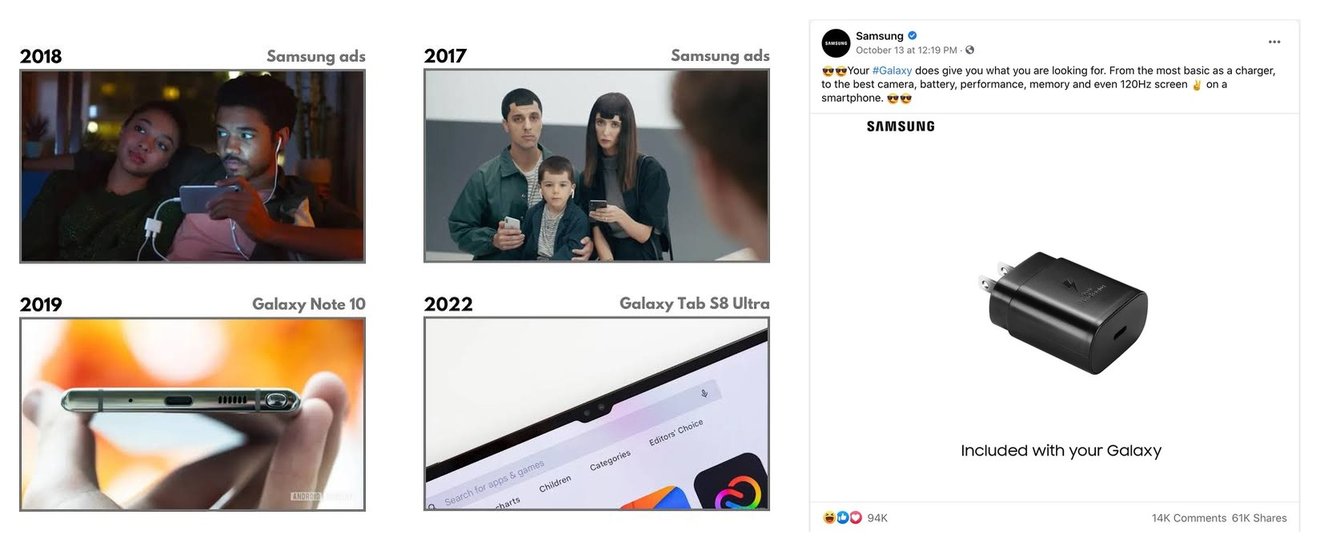
To be fair, Samsung had a point: dropping the charger and the headphone jack were anti-consumer moves, and I'd still love a charger in the box. The problem isn't the criticism; it's criticising something and then doing it a year later. And notice who does the talking. Apple doesn't name Samsung. Even after the Duo launch, when Apple's Greg Joswiak complained that rivals had seen the leaks and "got the aspect ratio", he named no one, though Samsung, Huawei and Xiaomi had all just shipped wide foldables (ChannelNews).
Yes, Apple borrows too: the always-on display, home-screen widgets, and a foldable seven years after the Galaxy Fold. The difference is that Apple never mocked any of them first.
When an ugly stranger calls you twin
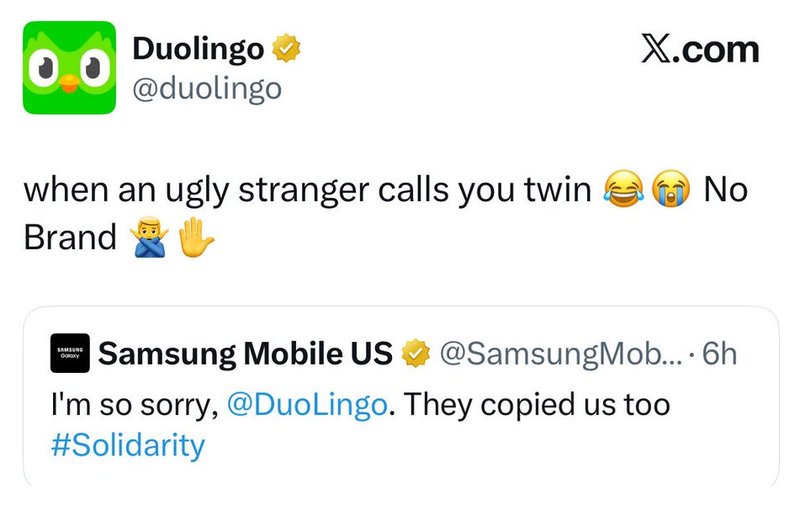
Samsung's most recent outburst came with the iPhone Duo. Within minutes of Apple unveiling its first foldable on 9 September 2026, Samsung Mobile US was live-posting jabs, from "let us know when you're done reheating our leftovers" to tagging Duolingo: "They copied us too #Solidarity" (Korea Herald).
The complaint doesn't hold up. Nobody owns the idea of a phone that folds. And the wide, passport-style shape Samsung now sells as the Galaxy Z Fold 8 only arrived in July, two months ahead of the Duo, after a year of reports that Apple's foldable would use a similar wide aspect ratio (ChannelNews).
Duolingo had the best response of the day. It brushed Samsung off: